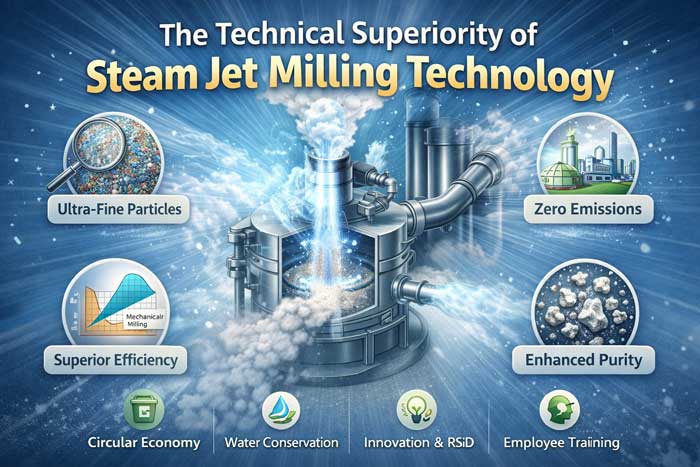
Steam Jet Milling represents the pinnacle of micronization technology for high-purity minerals. Unlike traditional ball mills or even air jet mills, this process uses superheated steam as the grinding medium. The article explains the physics behind this: steam has a higher sonic velocity than air, which allows for higher-energy collisions between talc particles. This results in an incredibly fine particle size distribution (D_{97} < 8\mu m) without the risk of metallic contamination, as there are no moving grinding parts. One of the most critical advantages discussed is the preservation of the “lamellarity” or the plate-like structure of the talc. Maintaining these plates is vital for …

The Role of Ultra-Fine Talc in EV Lightweighting Detailed Analysis: The global transition toward Electric Vehicles (EVs) has placed “lightweighting” at the forefront of automotive engineering. As battery packs add significant weight to vehicles, manufacturers must compensate by reducing the mass of other components. High-aspect-ratio talc, such as the ST-Nano series, is emerging as a critical solution. When incorporated into polypropylene (PP) and other thermoplastic olefins (TPO), nano-talc acts as a powerful reinforcing agent. It allows for “thin-walling”—the production of thinner parts that maintain the same structural integrity as thicker, traditional components. This reduction in density directly translates to extended battery range and better performance. …
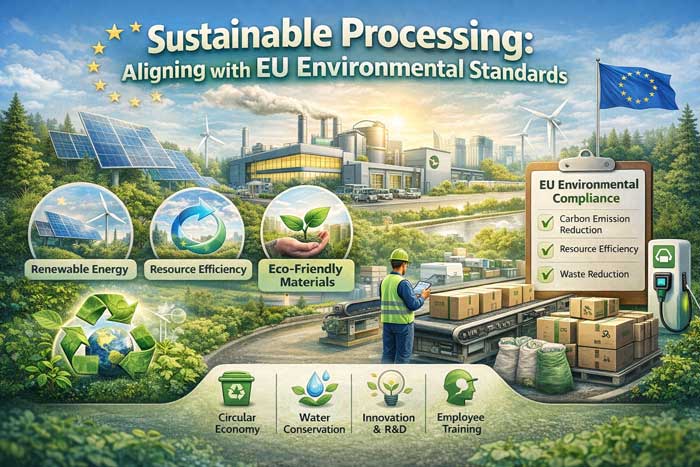
Our company is dedicated to integrating sustainable processing practices throughout every stage of our production. We actively monitor and optimize our operations to minimize environmental impact, reduce waste, and improve overall resource efficiency. By aligning our processes with the stringent environmental standards established by the European Union, we ensure full compliance while fostering a culture of accountability and responsibility. This commitment extends to the adoption of renewable energy sources and the integration of eco-friendly technologies that help us reduce carbon emissions and enhance operational sustainability. Water management and energy conservation are central to our sustainable practices. We implement advanced monitoring systems to track consumption, prevent …