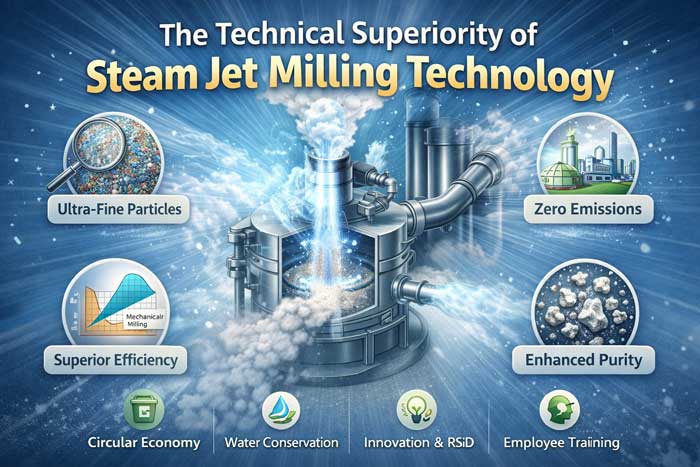
Steam Jet Milling represents the pinnacle of micronization technology for high-purity minerals. Unlike traditional ball mills or even air jet mills, this process uses superheated steam as the grinding medium. The article explains the physics behind this: steam has a higher sonic velocity than air, which allows for higher-energy collisions between talc particles. This results in an incredibly fine particle size distribution (D_{97} < 8\mu m) without the risk of metallic contamination, as there are no moving grinding parts. One of the most critical advantages discussed is the preservation of the “lamellarity” or the plate-like structure of the talc. Maintaining these plates is vital for reinforcing applications in polymers and coatings. The thermal energy of the steam also helps in drying the mineral simultaneously, ensuring a moisture-free final product. For Silk Talc Group, this technology is the “unique selling proposition” (USP). It allows for the production of high-end grades that are required in the pharmaceutical, cosmetic, and specialty polymer industries. The article concludes that while the initial capital expenditure for steam jet systems is higher, the operational efficiency and product quality provide a superior return on investment (ROI).
Your Comment